
How to Choose the Right Senior Care(2026 Guide)
When an aging parent, spouse, or loved one begins needing more help, families are often overwhelmed by the options. One person says “We need home health.” Another says “It’s time for assisted living.” The hospital discharge planner recommends skilled nursing. Someone else mentions memory care. Knowing how to choose the right senior care setting can prevent costly mistakes and keep your loved one safer.
As a registered nurse with over 30 years of experience, a PhD in Clinical Psychology, and over 13 years running a home health agency in Texas, I’ve watched hundreds of families struggle with this exact decision — usually during a crisis when emotions are running high and time feels short.
The right care setting depends on your loved one’s medical condition, safety needs, memory status, mobility, ability to perform daily activities, and how much support the family can realistically provide. This guide walks you through every option so you can choose based on reality, not panic.
Start With the Real Question
Before choosing a care setting, ask one simple but critical question: What is no longer safe or manageable at home?
The answer might include bathing, dressing, toileting, walking, medication management, wound care, meal preparation, memory supervision, therapy, nursing care, or 24-hour monitoring.
From a nursing perspective, families should not choose care based only on age or diagnosis. A diagnosis matters, but function matters more. Two people may both have dementia, but one may still live safely at home with supervision while another may wander, fall, forget medications, or create dangerous situations around the stove.
The decision should always come back to this: What does my loved one need help with right now, and what is the safest way to provide that help?
Option 1 — Home Health Care
Home health care is best when the person is homebound, has a physician’s order for skilled services, and can safely remain at home between visits with adequate support.
Home health services may include skilled nursing visits, physical therapy, occupational therapy, speech therapy, wound care, medication education, disease management, and recovery support after hospitalization.
Home health may be appropriate when your loved one recently came home from the hospital and needs monitoring during recovery, has wounds, medication changes, diabetes, heart failure, COPD, or progressive weakness, needs rehabilitation but can safely remain at home, has a physician order for skilled care, and has family or caregiver support between visits.
What families need to understand: Home health is not full-time caregiving. A nurse or therapist may visit for 30 to 60 minutes a few times per week — they do not stay all day. If your loved one needs help with bathing, toileting, meals, supervision, or safety throughout the day, you will also need private-duty caregivers, family support, or a different care setting entirely.
Medicare covers home health at no cost to the family when eligibility criteria are met — but only for skilled, intermittent care. It does not cover 24-hour caregivers or long-term custodial help.
Option 2 — Private-Duty Home Care
Private-duty home care fills the gap that home health doesn’t cover — the ongoing, non-medical daily support that keeps your loved one safe at home.
Private-duty caregivers help with bathing, dressing, meal preparation, companionship, transportation, light housekeeping, medication reminders, and supervision. This care can range from a few hours a day to 24-hour live-in support.
Private-duty care may be appropriate when your loved one is medically stable but needs daily help with personal care and household tasks, feels isolated or lonely and benefits from companionship, needs supervision for mild cognitive impairment or fall risk, and when family caregivers need reliable support or respite.
The cost in Texas: Through an agency in the Houston area, expect $28 to $38 per hour depending on care complexity. Independent caregivers may charge $25 to $26 per hour, but the family takes on employer responsibilities including taxes, insurance, and backup coverage.
Private-duty home care is almost always private pay. Medicare does not cover it. Some long-term care insurance policies and VA Aid and Attendance benefits may help offset the cost.
Option 3 — Assisted Living
Assisted living is the right choice when a senior does not need hospital-level or skilled nursing care every day, but is no longer safe or comfortable living alone.
Assisted living provides a residential setting with meals, personal care assistance, medication management, social activities, housekeeping, and 24-hour staff availability. The focus is on maintaining independence and dignity while providing the daily support needed.
Assisted living may be appropriate when your loved one needs regular help with bathing, dressing, meals, or medications, feels isolated and would benefit from social engagement and structured activities, is having falls or near-falls at home, cannot safely manage housekeeping, cooking, or transportation, and does not require intensive nursing care around the clock.
The cost in Texas: The average is $4,500 to $5,250 per month, with significant variation by city and care level. Additional care surcharges of $500 to $2,000 or more per month are common when residents need higher levels of personal assistance.
Medicare does not pay for assisted living. Families typically pay privately, through long-term care insurance, VA benefits, or Texas Medicaid (STAR+PLUS) for those who qualify.
What assisted living cannot provide: If your loved one needs complex wound care, IV medications, ventilator care, frequent skilled nursing assessment, or intensive rehabilitation, assisted living is not enough.
Option 4 — Memory Care
Memory care is specifically designed for people living with Alzheimer’s disease, dementia, or other cognitive impairments who need a secure, structured environment with staff trained in dementia care.
Memory care may be appropriate when your loved one wanders or tries to leave the home, gets lost in familiar places, leaves the stove on or creates safety hazards, cannot manage medications, has increasing confusion, agitation, or anxiety, needs supervision throughout the day and night, has become unsafe in regular assisted living, or exhibits behaviors like aggression, paranoia, or sundowning that require specialized management.
From a clinical psychology perspective, memory care is not just about locked doors and supervision. It is about reducing fear, confusion, and overstimulation. People with dementia often do better with predictable routines, simplified environments, familiar cues, and staff who know how to redirect rather than argue. A good memory care community meets the person where their brain is — not where we wish it was.
The cost in Texas: Typically $6,000 to $7,500 per month, and can exceed $8,000 in major metro areas. Memory care costs more than standard assisted living because of the higher staffing ratios, secured environment, and specialized programming required.
Families often wait too long because of guilt. But if a loved one is wandering, falling, becoming aggressive, missing medications, or can no longer recognize danger, memory care is often the safer and more compassionate choice.
Option 5 — Skilled Nursing Facility
A skilled nursing facility provides a higher level of medical care than assisted living. It may be used for short-term rehabilitation after hospitalization or for long-term care when medical and functional needs are too high for other settings.
Skilled nursing may be appropriate when your loved one needs 24-hour nursing care, has complex medical needs like wound care, tube feeding, IV therapy, or ventilator management, is recovering from surgery, stroke, hip fracture, serious infection, or prolonged hospitalization, cannot safely transfer, walk, toilet, or perform basic activities, needs intensive rehabilitation before returning home, or has care needs that exceed what assisted living or home care can provide.
Short-term vs long-term: Short-term skilled nursing focuses on recovery and getting the patient home. Long-term nursing home care is for people who need ongoing high-level medical support and cannot safely live in a less supervised setting.
The cost in Texas: Approximately $5,000 to $5,500 per month for a semi-private room, $7,000 to $7,500 per month for a private room. Medicare may cover up to 100 days after a qualifying 3-day inpatient hospital stay — days 1 through 20 at no cost, days 21 through 100 with a $217 daily copay in 2026.
Option 6 — Rehab After Hospitalization
Rehabilitation is often provided in a skilled nursing facility after a hospital stay. The goal is to help the person regain strength, mobility, independence, and function so they can return home safely.
Rehab may be appropriate after hip fracture or joint replacement, stroke, serious fall, major surgery, pneumonia or severe infection, prolonged hospital stay, or significant weakness and deconditioning.
What families should know: Rehab typically involves one to two hours of physical therapy, occupational therapy, or speech therapy per day. The rest of the time is spent resting and recovering. Progress is not always fast or linear — a patient may do well one day and struggle the next.
Not everyone returns to their previous level of function. Sometimes rehab reveals that the person needs more ongoing care than expected. A good rehab plan should answer: What are the therapy goals? How often will therapy occur? What does my loved one need to accomplish before going home? What equipment will be needed at home? Will home health be ordered after discharge?
The Biggest Mistake — Choosing Based on Emotion Alone
Families often make care decisions from guilt, fear, or crisis pressure. A daughter says “I promised Mom I’d never put her anywhere.” A spouse says “I can still manage” while running on empty. Siblings disagree because they each see different parts of the situation.
These emotions are completely normal. But the decision should be based on safety, care needs, and quality of life not guilt.
From a clinical psychology perspective, guilt can cloud judgment. Families sometimes confuse love with doing everything themselves. But love also means recognizing when the current arrangement is no longer safe and having the courage to change it.
The question is not “What do we wish were true?” The question is “What level of care does our loved one need right now?”
Senior Care Decision Guide for Texas Families
Home health may be right if your loved one is homebound, medically stable enough to remain at home, and needs skilled nursing or therapy visits with adequate support between visits.
Private-duty home care may be right if your loved one mainly needs help with bathing, meals, transportation, companionship, or supervision — but not ongoing skilled medical care.
Assisted living may be right if your loved one needs daily help with personal care and social support but does not need 24-hour skilled nursing care.
Memory care may be right if dementia, wandering, unsafe judgment, agitation, or the need for constant supervision is the primary concern.
Skilled nursing or rehab may be right if your loved one needs 24-hour nursing care, intensive therapy, complex medical support, or recovery after hospitalization.
Watch for These Early Warning Signs
Families often wait until a major crisis forces a decision. But small changes can be early warnings that the current care plan isn’t enough:
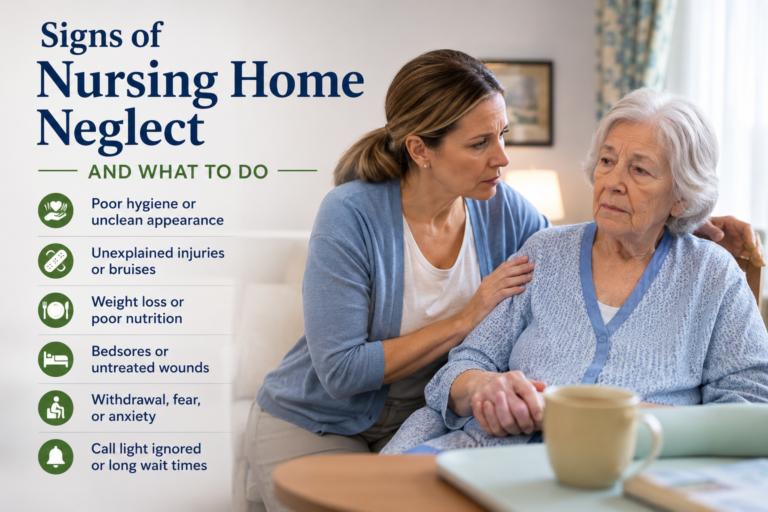
More frequent falls. Unexplained weight loss. Declining personal hygiene. Medication mistakes or missed doses. New or worsening confusion. Increasing weakness or fatigue. Missed medical appointments. Burned food or kitchen safety incidents. Unpaid bills or financial mismanagement. Caregiver exhaustion or health problems. Repeated hospitalizations or ER visits.
If you’re seeing several of these signs, it’s time to seriously evaluate whether a change in care is needed — before a crisis makes the decision for you.
Care Transitions Are Emotional and That’s Normal
Moving from home to assisted living, memory care, or skilled nursing brings grief, fear, anger, guilt, and sadness for both the senior and the family.
The first few weeks are usually the hardest. Your loved one may ask to go home, become tearful, refuse to eat, or resist participation. That doesn’t necessarily mean the decision was wrong. It often means they’re grieving a loss of independence and adjusting to a major life change.
Your role during this transition is to provide reassurance, consistency, and calm support — while making sure care needs are actually being met. Visit regularly. Bring familiar items. Talk to the staff. Attend care conferences. And give yourself permission to feel your own emotions without letting them override what you know is right.
Need Help Choosing the Right Care in Texas?
Choosing between home health, private-duty care, assisted living, memory care, skilled nursing, and rehab is one of the hardest decisions a family will face. You shouldn’t have to figure it out alone especially not in the middle of a crisis.
At RightCareFinder, a registered nurse with a PhD in Clinical Psychology personally reviews your loved one’s situation, their medical needs, cognitive status, safety concerns, family support, and financial resources and helps you find the right care setting and the right providers in Texas.
Our service is completely free for families. Get nurse-guided help at RightCareFinder.com or click Get Free Help Now.
This article is for informational purposes only and does not constitute medical, financial, or legal advice. Care needs and costs vary. Always consult with your loved one’s healthcare provider and verify current information with relevant agencies before making care decisions.