Pediatric Private Duty Nursing in Texas: What Families Need to Know (2026)
When a child is medically fragile, home is not simply “home.” It becomes a place where parents manage feeding tubes, tracheostomies, ventilators, oxygen, seizures, medications, suction machines, monitors, emergency plans, insurance authorizations, school care needs, and constant fear. Pediatric private duty nursing in Texas can be life-changing for these families — but the gap between what the system promises and what families actually receive is often devastating.
As a registered nurse with over 30 years of clinical experience and a PhD in Clinical Psychology, I have seen how pediatric private duty nursing transforms families when it works — and how it fails them when the system breaks down. This guide gives Texas families the unfiltered truth about what pediatric PDN is, how to navigate Texas Medicaid programs, what to do when authorized hours aren’t staffed, and how to protect both your child and your family.
What Pediatric Private Duty Nursing Actually Is
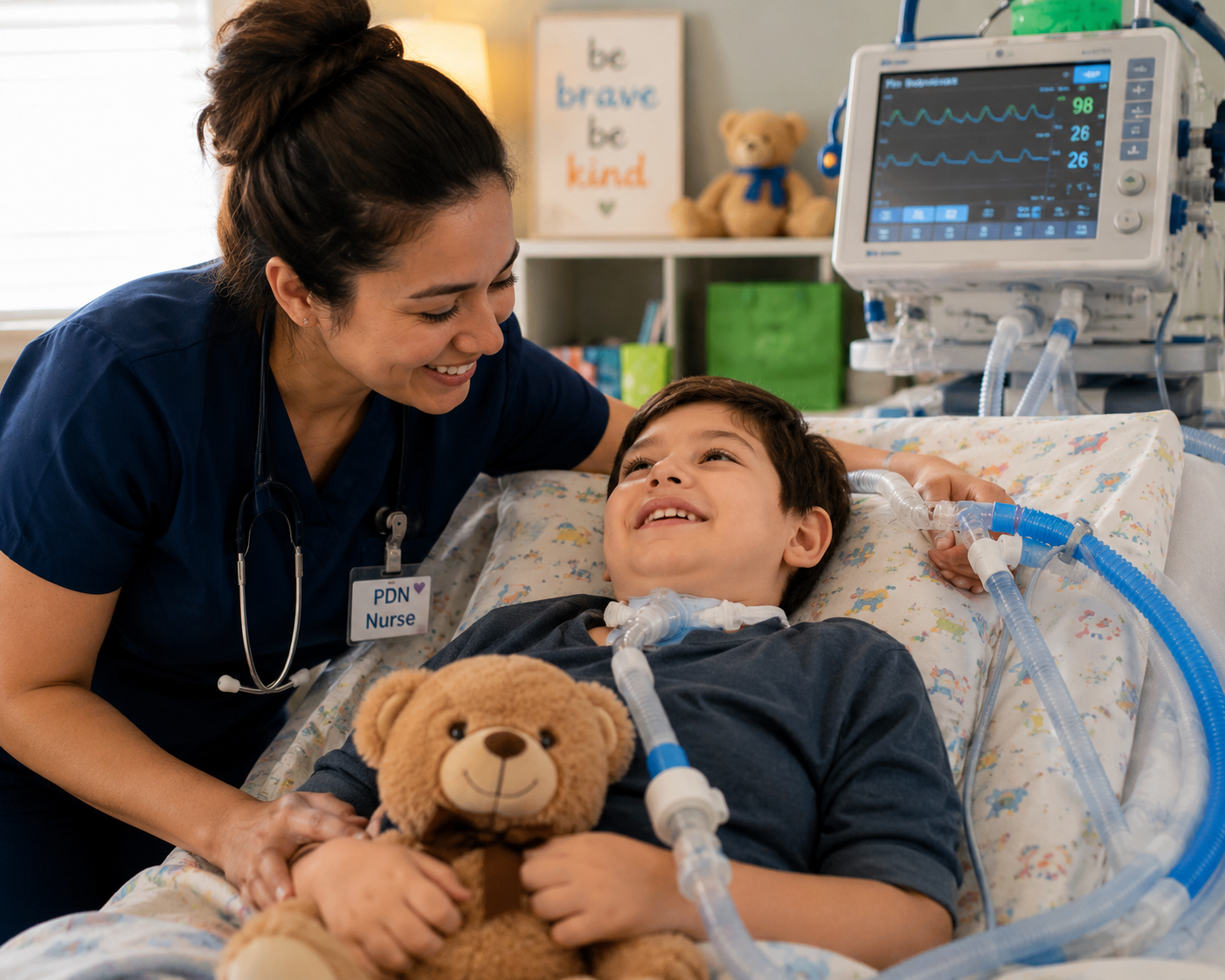
Pediatric private duty nursing is extended one-on-one skilled nursing care provided by a licensed nurse — an RN or LVN — to a child with complex medical needs. It is fundamentally different from a short home health visit. A private duty nurse may work shifts of several hours at a time, sometimes during the day, overnight, at school, or immediately after hospital discharge.
This is skilled clinical care — not babysitting, not companion care, not “watching the child.” It requires nursing judgment, documentation, emergency awareness, medication administration, equipment management, family communication, and detailed knowledge of the child’s medical condition. The nurse’s role is to provide continuous skilled monitoring and intervention because the child’s condition can change quickly and requires a licensed professional to respond.
Private Duty Nursing vs Home Health vs Personal Care
Families hear many terms and understandably get confused. The distinctions matter because choosing the wrong level of care can be dangerous.
Home health nursing provides intermittent skilled visits. A nurse comes for a scheduled visit — typically 30 to 60 minutes — performs an assessment or treatment, teaches the family, documents, and leaves. This is short-term, task-oriented care usually covered by Medicaid or insurance when the patient meets eligibility criteria.
Personal care services help with activities of daily living — bathing, dressing, feeding assistance, toileting, and mobility support. These are important but are not licensed skilled nursing interventions.
Pediatric private duty nursing provides extended skilled nursing care for children whose medical conditions require continuous clinical monitoring. The nurse stays for the entire shift — 8, 10, 12, or more hours — providing hands-on skilled care, watching for changes, and intervening when needed.
The critical question is not “Does this child need someone in the room?” It is “Does this child need a licensed nurse present because their condition requires continuous skilled clinical judgment?”
Types of Pediatric Patients Who Need Private Duty Nursing
Over the years of running my agency, I’ve served children with tracheostomies, ventilator dependence, oxygen needs with unstable respiratory status, frequent suctioning requirements, feeding tubes including G-tubes and J-tubes, TPN or complex nutritional support, seizure disorders requiring close monitoring, cerebral palsy with complex medical needs, severe developmental disabilities, genetic disorders, congenital heart disease, prematurity-related complications, neurological impairment, spinal muscular atrophy and other neuromuscular conditions, brain injury, chronic respiratory disease, complex medication schedules, high aspiration risk, and technology dependence after NICU or PICU discharge.
These children need more than “help.” They need a nurse who can recognize early warning signs, respond immediately, follow physician orders, troubleshoot equipment, and support the family’s care plan — all while keeping a medically fragile child alive and stable.
Texas Medicaid Programs Every Family Should Know
In Texas, many medically fragile children receive pediatric private duty nursing through Medicaid managed care programs. Understanding these programs is essential.
STAR Kids is a Texas Medicaid managed care program for children and young adults age 20 and younger who have disabilities. It provides Medicaid benefits through a health plan network and includes benefits such as private duty nursing, personal care services, durable medical equipment, supplies, prescription drugs, hospital care, primary care, specialty care, and preventive care.
MDCP — the Medically Dependent Children Program — provides community-based services for children and young adults who are medically dependent. It encourages keeping children in family homes rather than institutions and provides services including respite, flexible family support, minor home modifications, adaptive aids, and transition assistance through STAR Kids or STAR Health managed care organizations.
STAR Kids health plans are not the same in every county. Texas is divided into managed care service areas, and the available MCOs depend on where the child lives. Plans may include Superior, Wellpoint, UnitedHealthcare, Texas Children’s Health Plan, Molina, Blue Cross and Blue Shield of Texas, Dell Children’s, Driscoll, Community First, or others depending on the service area.
View the Texas Managed Care Service Areas Map
MCO choice matters. Agency choice matters. County matters. Families should check the official Texas HHS managed care service areas map and ask which STAR Kids MCOs serve their specific county. The right MCO and the right agency can make the difference between consistent nursing coverage and endless uncovered shifts.
The Brutal Truth — Authorized Hours Do Not Mean Staffed Hours
This is the single most painful reality in pediatric private duty nursing in Texas, and every family needs to understand it before discharge.
A child may be approved by Medicaid or the STAR Kids MCO for a significant number of nursing hours per week. The authorization looks strong on paper. But if the agency cannot find nurses to cover those shifts, the family receives a fraction of the approved hours.
Parents understandably ask: “The insurance approved 80 hours — so why am I only getting 30?” The answer is almost always staffing.
However, families should know that STAR Kids MCOs have contractual obligations to provide authorized PDN services. When authorized hours are consistently not being staffed, families have the right to escalate.
From a family perspective, the gap between authorized and staffed hours is not a bureaucratic detail. It is sleep deprivation. It is a parent who can’t work. It is a child whose safety depends on a nurse who doesn’t show up. It is the difference between surviving and collapsing.
The Pediatric PDN Staffing Crisis in Texas
Texas families are living through a real pediatric private duty nursing staffing crisis. Not every nurse is trained or willing to work with tracheostomies, ventilators, seizures, night shifts, school cases, or high-acuity children.
Agencies struggle to staff cases because of a limited supply of pediatric-trained nurses, reimbursement rates that are low compared to hospital and facility jobs, long shift hours that are physically and emotionally demanding, rural distances that make travel impractical, night and weekend scheduling that most nurses avoid, complex cases requiring extensive specialized training, nurse burnout from the intensity of pediatric PDN, school scheduling complications, the administrative burden of MCO documentation and authorization requirements, and nurses preferring adult care or facility work where the environment is more structured.
Parents feel abandoned when shifts are uncovered. The agency may say “We are trying,” but the parent is still the one awake at 2am suctioning, managing alarms, giving medications, and somehow getting ready for work the next morning.
When Large Agencies Accept Cases They Cannot Staff
This is a sensitive issue, but families deserve honesty.
Some large home health agencies accept many pediatric PDN referrals because they have strong marketing relationships with hospitals, discharge planners, and case managers. They are well-known and easy to refer to. The problem occurs when an agency accepts a child’s case but cannot actually staff the authorized hours.
The child is discharged. The family believes help is coming. Then the family receives only partial coverage — or repeated cancellations that leave them alone with a medically fragile child.
This does not mean every large agency is bad. Many do excellent work. But size alone does not guarantee staffing. A big name does not mean your child will receive their full authorized nursing hours.
Meanwhile, smaller agencies may provide more consistent staffing because they focus closely on fewer patients, know their nurses personally, and work harder to match the right nurse to the right child. But many small agencies lack marketing teams, so hospital discharge planners may not know they exist.
Families should not assume the first agency offered by the hospital is the only option. Ask for multiple agency options. Ask specifically: “How many of my child’s authorized hours can you actually staff right now?”
NICU to Home — The Most Terrifying Transition
The NICU-to-home transition is one of the most emotional experiences a family can face. In the NICU, monitors, nurses, respiratory therapists, and physicians are always nearby. At home, the parents suddenly become the front line.
For babies going home with tracheostomies, ventilators, oxygen, feeding tubes, apnea monitors, or complex medications, private duty nursing may be essential for survival.
Before discharge, families need hands-on training for every skilled task they’ll be expected to perform, CPR certification, equipment education for every device their child uses, medication teaching, feeding plan instruction, suctioning and tracheostomy care training, a backup equipment plan, a power outage plan, an emergency transportation plan, a confirmed agency start-of-care plan with actual nurse availability, and contact information for the MCO, agency, DME company, and physician.
Discharge should not happen simply because the child is medically stable. Discharge should happen when the home is prepared, the caregivers are trained, equipment is in place, and nursing support is confirmed and realistic — not promised on paper.
School Nursing Complications
School nursing for medically fragile children adds another layer of complexity. A child may need nursing support during transportation, classroom time, feeding, medication administration, suctioning, seizure monitoring, or emergency response.
Parents may assume the school provides everything. The school may say the Medicaid PDN nurse should attend. The agency may say they can’t staff school hours. The MCO may have specific rules. The family gets caught in the middle.
Families must clarify: Does the child need a nurse during school? Who is responsible for nursing coverage during school hours? What does the child’s IEP or 504 plan say? What does the physician order specify? What does the MCO authorize? Does the agency have nurses willing to work school hours? What emergency plan is on file at school?
Children with medical complexity deserve education access, but the safety planning must be specific and realistic.
How to Get Approved for PDN Hours
Approval for pediatric private duty nursing requires documentation of medical necessity. The process varies by MCO but generally requires physician orders, a plan of care, nursing assessment, medical records, and documentation showing why continuous skilled nursing is needed.
Families can strengthen authorization requests by documenting frequency of suctioning, respiratory treatment schedules, oxygen desaturation events, ventilator requirements, feeding tube needs and aspiration risk, seizure frequency and interventions required, medication administration needs, nighttime care requirements, recent hospitalizations or ER visits, skilled tasks parents are currently performing themselves, caregiver exhaustion and safety concerns, and the need for nursing at school.
If hours are denied or reduced, families should ask about the appeal process, whether additional clinical documentation can be submitted, whether a peer-to-peer review can be requested between the child’s physician and the MCO medical director, and how school hours are handled separately.
Your Rights as a Family
Families are not powerless in this system. Texas families have the right to choose their agency. If the current agency cannot staff authorized hours, families can request a list of other in-network PDN agencies from their MCO service coordinator.
Families can request an MCO plan change by calling the Texas STAR/STAR Kids Program Helpline at 1-800-964-2777. If you call on or before the 15th of the month, the change takes effect the first day of the next month. If you call after the 15th, the change takes effect the first day of the second month.
Families should also ask whether multiple agencies can cover different shifts for the same child, whether the MCO can help locate additional providers, what the formal complaint process is if authorized services are not being delivered, and whether the MDCP/DBMD escalation helpline can help — that number is 1-844-999-9543.
Changing agencies is not punishment. It is advocacy for your child’s safety.
Keep a Missed-Shift Log
Families should document the gap between approved and actual staffed hours. A simple log should include the date, the authorized shift time, whether a nurse came, whether the agency notified you of a cancellation, how many hours were uncovered, any safety concerns that occurred during uncovered hours, and whether the MCO service coordinator was notified.
This documentation is powerful when advocating with the agency, the MCO, and the state. Without it, complaints are harder to substantiate.
Families Have Responsibilities Too — The Honest Truth
This is a topic that must be discussed honestly. Families deserve reliable nursing support. But PDN nurses also deserve a safe, respectful work environment.
I have seen situations where families place extreme stress on nurses — yelling, cursing, humiliating, blaming, or demanding constant nurse changes without reasonable clinical justification. When this happens, nurses do not want to return. Over time, the child becomes harder to staff — not because of medical complexity, but because the home environment is hostile.
Parents are exhausted, frightened, and under tremendous pressure. I understand that deeply. But verbal abuse and constant disrespect toward nurses will not improve care. It causes nurses to leave, which makes the staffing crisis worse for your child.
A medically fragile child needs a stable nursing team. Stability is built through mutual respect.
What families should expect from PDN nurses: arrive on time, follow the care plan, provide skilled nursing within scope, document accurately, monitor the child’s condition, communicate changes, maintain professional boundaries, and respect the child and family.
What families should not ask PDN nurses to do: clean the entire house, care for siblings, cook family meals, run personal errands, do family laundry, care for pets, babysit other children, stay beyond scheduled hours without agency approval, or ignore documentation and safety protocols.
A nurse may keep the child’s care area clean, organize patient-related supplies, and perform tasks directly related to the child’s nursing care. But the nurse’s primary attention must remain on the medically fragile child. When families pull nurses into unrelated household duties, the child’s safety is compromised.
The most successful PDN cases happen when families and nurses work as a team. The parent knows the child deeply. The nurse brings clinical skill. The agency provides supervision. The MCO authorizes benefits. When everyone respects their role, the child receives better care.
The Emotional Toll on Families
Parents of medically complex children live in chronic survival mode. The monitor alarm, the oxygen desaturation, the seizure episode, the nurse cancellation — each one triggers immediate panic.
From a clinical psychology perspective, these parents often experience chronic sleep deprivation, anxiety and hypervigilance, depression symptoms, financial stress, marital strain, guilt about siblings who don’t get enough attention, career disruption, fear of losing nursing hours, terror of hospitalization, guilt for wanting rest, and trauma from repeated medical crises.
A parent asking for nursing coverage is not asking for luxury. They are asking for safety, sleep, and the ability to function as a human being. These families need support, not judgment.
How Pediatric PDN Prevents Hospitalization
A skilled pediatric nurse acts as an early warning system. By monitoring subtle changes — increased secretions, slight oxygen desaturation, changes in respiratory rate, feeding intolerance, seizure pattern shifts, dehydration signs, early infection symptoms, or equipment malfunction — a nurse can intervene before a manageable situation becomes an ICU admission.
For medically fragile children, small changes become big emergencies quickly. The difference between catching a developing pneumonia at home and treating it in a bedroom versus catching it 12 hours later in an emergency room can be tens of thousands of dollars in hospital costs — and weeks of setback for the child.
That is what pediatric private duty nursing does at its best: it turns potential catastrophes into managed clinical moments through continuous skilled observation.
Red Flags in Pediatric PDN Agencies
Be cautious if an agency accepts the case without honestly discussing staffing reality, cannot explain how many hours they can actually cover, sends nurses without pediatric-specific training, sends nurses unfamiliar with tracheostomies, ventilators, or seizure management when those are required, has poor after-hours communication, does not provide RN supervision, does not update the care plan as the child’s condition changes, avoids discussing uncovered shifts, blames the family instead of problem-solving, has frequent nurse turnover with no explanation, pressures families not to complain to the MCO, or documents hours that were not actually worked.
If authorized services are consistently not being provided, notify the MCO service coordinator in writing and ask for help finding additional in-network providers.
Real Situations Texas Families Face
I have seen families come home from the NICU with a child requiring frequent suctioning, only to have the night nurse cancel on the first night. The parent stayed awake all night watching the child breathe.
I have seen a mother approved for extensive PDN hours receive only a fraction because the agency could not staff the case. On paper, support existed. In real life, she was alone.
I have seen small agencies work extremely hard to cover shifts but struggle to get referrals because discharge planners automatically sent families to larger agencies with stronger marketing relationships.
I have seen children avoid hospitalization because a private duty nurse recognized respiratory distress early, notified the physician, adjusted care within the plan, and prevented a crisis.
I have seen families hesitate to complain because they feared losing the few nursing hours they had. That fear is real — but families have the right to speak up, and speaking up is often how coverage improves.
What to Ask Before Choosing a Pediatric PDN Agency
Before accepting an agency, ask: Are you licensed in Texas as a HCSSA? Are you in network with my child’s STAR Kids MCO? How many of the authorized hours can you staff right now — honestly? Do you have pediatric nurses in my county? Do you have nurses specifically trained in my child’s medical needs? How do you verify nurse competency for tracheostomy, ventilator, seizure, and feeding tube care? Who is the RN supervisor and how often do they visit? What happens when a nurse calls out? Can you staff school hours, nights, and weekends? How do you communicate missed shifts? Can we use another agency for uncovered hours? Will you help with authorization documentation? How do you coordinate with the MCO service coordinator?
A truthful answer like “We can staff 40 of the 80 authorized hours right now and are actively recruiting for the rest” is infinitely better than a false promise that leaves your child uncovered.
Need Help Finding Pediatric Private Duty Nursing in Texas?
Navigating pediatric private duty nursing in Texas — STAR Kids MCOs, MDCP, authorization processes, staffing gaps, and agency selection — is overwhelming for families already managing a medically fragile child. At RightCareFinder, a registered nurse personally reviews your child’s medical needs, your county’s MCO options, and your family’s situation to help you find agencies that can actually staff your child’s authorized hours.
Our service is completely free for families. Get nurse-guided help at RightCareFinder.com or click Get Free Help Now.
This article is for informational purposes only and does not constitute medical, legal, or insurance advice. Texas Medicaid programs, MCO networks, and PDN policies can change. Always verify current information with your child’s MCO, the Texas HHS website, or a qualified healthcare professional. For STAR Kids concerns, contact the MDCP/DBMD escalation helpline at 1-844-999-9543. To change your STAR Kids health plan, call 1-800-964-2777.