
How to Choose the Right Memory Care Community (2026)
Most families choose a memory care community based on the chandelier in the lobby, the crown molding, or the friendly marketing director who offered them a fresh-baked cookie. That is a potentially devastating mistake. A beautiful lobby can easily mask a clinical disaster. When you choose memory care, you aren’t paying for real estate — you are paying for specialized, intensive behavioral and physical management of a progressive brain disease.
As a registered nurse with over 30 years of experience, a PhD in Clinical Psychology, and over 13 years running a home health agency where I worked closely with memory care communities, I know exactly how the senior care industry hides its deficits behind fresh paint and friendly tours. If you want to protect your loved one from institutional neglect and your family from financial ruin, you must look past the aesthetics and evaluate like a clinician.
What Memory Care Actually Is
Memory care is specialized residential care for people living with Alzheimer’s disease, dementia, or related cognitive disorders. It provides a more secure environment than standard assisted living, with structured routines, dementia-trained staff, 24-hour supervision, activities designed for cognitive impairment, assistance with all daily living tasks, and support for behaviors like wandering, agitation, paranoia, and sundowning.
In Texas, facilities that advertise memory care services may be subject to specific disclosure and certification requirements. Families should ask to see the facility’s Memory Care Disclosure Statement during their visit — this is a document that Texas regulations require for facilities marketing memory care services.
A Good Memory Care Community vs a Bad One
A good memory care community does far more than lock doors. It creates a safe, structured, dignified environment where staff understand dementia behavior and respond with clinical skill and patience — not sedation and 911 calls.
A good community has dementia-specific staff training in recognized curricula, consistent staffing with low turnover, secure but welcoming design with safe wandering paths, meaningful activities adapted to different cognitive stages, calm dining support with nutrition monitoring, comprehensive fall prevention, proper medication management, effective wandering prevention that doesn’t feel like prison, regular family communication, care plans that evolve as the disease progresses, staff who know residents personally by name and history, and clear protocols for behavioral challenges including sundowning and aggression.
A bad community may have a stunning lobby and impressive marketing but weak staffing, minimal real dementia programming, poor communication, revolving-door staff turnover, vague answers to clinical questions, and residents lined up in wheelchairs along hallways staring at blank walls or chaotic television.
Do Not Be Distracted by the Lobby
This cannot be stated strongly enough. The lobby is designed to soothe your guilt, not to reflect the quality of care your parent will receive. Your parent doesn’t need granite countertops — they need an aide who knows that a sudden spike in confusion means they need a urinalysis, not a restraint.
When touring, demand to see beyond the showcase areas. Ask to see the actual memory care unit where residents live, the dining area during an actual meal, activity spaces during programming, resident bathrooms, the outdoor courtyard, hallways during late afternoon when sundowning may occur, actual resident rooms, and how staff interact with residents when they don’t know you’re watching.
Late afternoon tours are especially revealing. A good community should have a calm, structured plan for the sundowning hours. If you visit at 5pm and find chaos, fear, and no staff intervention, that tells you everything the brochure won’t.
Red Flags That Should Stop You in Your Tracks
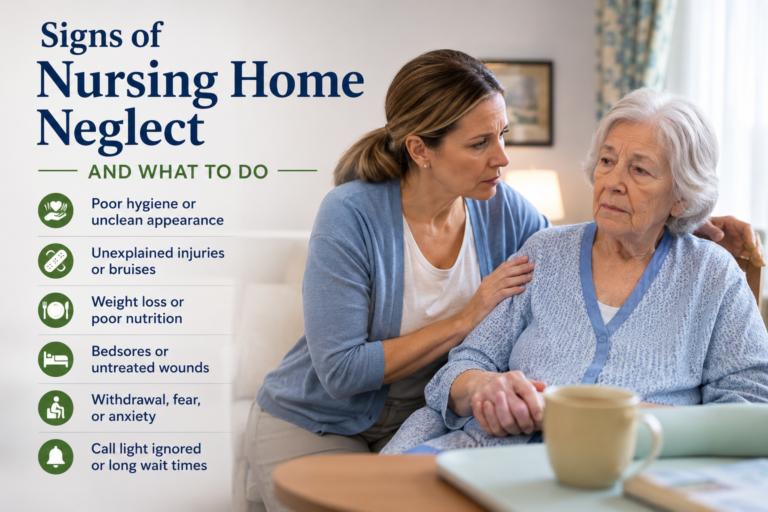
During any memory care tour, be cautious if you notice strong persistent odors of urine or stool, residents sitting alone with no engagement or stimulation, staff ignoring residents or call lights, staff speaking harshly or rushing through care, residents appearing unclean or poorly groomed, vague or defensive answers about staffing numbers, high-pressure sales tactics or urgency to sign immediately, claims of “We can handle everything” with no clinical specifics, no clear wandering prevention protocol, no secure outdoor space where residents can safely walk, no dementia-specific activity schedule posted and in use, medication carts left unattended, admission that staff turnover is high or refusal to discuss it, restricted family visiting in certain areas, no clear behavior management policy, and staff who cannot explain step by step how they handle aggression, care refusal, or sundowning.
The “houseplant” test: Walk through the community at 2pm on a random Tuesday. Are residents lined up in wheelchairs along the hallway, slumped over, staring at a wall or a blaring television? If yes, that facility provides custody, not care. Residents should be engaged, moving, interacting — not warehoused.
Staff Training — The Difference Between Care and Custody
Every memory care brochure promises “specially trained dementia staff.” In reality, this often means the state-mandated minimum — a few hours of watching outdated training videos.
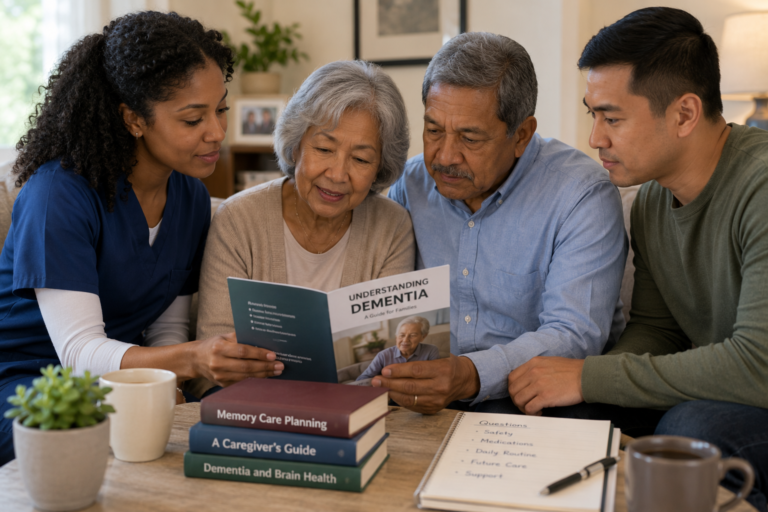
Dementia care requires an entirely different psychological and physical skill set than standard assisted living. Staff need to understand how dementia affects communication and why patients can’t “just remember,” how to redirect instead of argue or restrain, how to approach bathing and dressing resistance without escalating the situation, how to prevent and de-escalate aggressive episodes, how to respond to hallucinations and delusions therapeutically, how to manage sundowning with environmental and behavioral strategies, how to identify pain in a person who cannot verbally express it, how to reduce fall risk in people with impaired judgment and mobility, how to support eating and hydration in people who forget to chew or swallow, and how to preserve dignity during incontinence care.
Ask the executive director directly: “Are your staff certified in a specific, recognized dementia care curriculum?” Look for communities that use Validation Therapy, the Positive Approach to Care protocol, or similar evidence-based frameworks. If the answer is “We do in-house training” with no specifics, dig deeper.
The staff turnover question is critical. If a facility replaces 70% of its caregivers every year, your loved one will suffer. People with dementia rely on facial familiarity to feel safe. Constant new faces trigger confusion, anxiety, and behavioral escalation.
The 3am staffing ratio. Do not ask about daytime staffing when everyone is on their best behavior. Ask: “How many awake staff members are on the memory care floor between 11pm and 7am?” If there are 40 memory care residents and only two aides overnight, your parent may lie in a wet brief for hours — or fall out of bed with no one to hear them.
Architecture and Wandering Prevention — Design Matters
A poorly designed memory care unit is a psychological pressure cooker. When a brain with cognitive decline encounters dead-end hallways, locked doors, and confusing layouts, the result is frustration, pacing, panic, and escalation.
Continuous wandering paths. The best communities are designed in a secure, continuous loop or circle. Residents can walk as much as they need without hitting a locked door that screams “you are trapped.” Movement is a fundamental need for many people with dementia — the goal is to make movement safe, not to stop it.
Keypad camouflage. Well-designed communities disguise exit doors visually — painting them to blend with walls, covering them with murals, or using design elements that prevent the brain from registering an exit option. This reduces the agitation of “trying to escape” without physical confrontation.
Secure outdoor access. A facility that locks residents inside a dark wing all day is providing containment, not care. A good community has a secure, enclosed courtyard with hidden fencing where residents can walk outside, feel sunlight, touch plants, and breathe fresh air without triggering an alarm.
Safe interior environment. Look for adequate lighting throughout all areas, minimal clutter and fall hazards, grab bars in bathrooms, non-slip flooring, clear sightlines for staff, bedroom doors that are easily identifiable (some communities use different colors or personal memory boxes outside each door), and calm, non-institutional decor.
Evaluating Dementia-Specific Programming
Look past the activity calendar taped to the wall. Anyone can type “Aromatherapy and Trivia” on a schedule — very few communities actually execute meaningful programming consistently.
Good dementia programming is failure-free and engages the procedural memory that the disease leaves intact longer than other memory types. Look for life-skills stations with familiar tasks like folding towels or sorting items, music programs using songs from the resident’s era, gentle exercise and movement activities, sensory stimulation like textured items and aromatherapy, reminiscence activities using photos and familiar objects, simple art or craft projects adapted to ability level, gardening or plant care in the courtyard, spiritual support if desired, small-group engagement rather than only large-group activities, calm evening routines specifically designed for the sundowning hours, and individualized activities for residents who don’t join groups.
Ask the direct question: “What would my mother do here on a normal Tuesday afternoon?” If the answer is vague, that is a significant warning sign.
The 911 Test — How They Handle a Real Crisis
The ultimate test of any memory care community is how they handle a behavioral meltdown. When a resident with dementia becomes combative or severely paranoid, a bad facility calls 911 immediately and has the patient transported to a psychiatric ER — effectively evicting them from the community.
Ask the clinical director: “Tell me about the last time a resident became physically aggressive during care. What did your staff do step by step, and at what point did you call 911 or request a psychiatric evaluation?”
If their answer involves immediate chemical sedation or calling the police as a first response, walk away. A competent community uses behavioral de-escalation, environmental modification, pain assessment, infection screening, and medication review before treating a dementia symptom as a behavioral emergency. They call 911 as a last resort — not a first response.
The Financial Minefield — Cost Surprises and Hidden Charges
The base rate quoted by the sales director is almost never the final price. You must understand how memory care communities monetize your loved one’s progression.
The community fee trap. Many facilities charge a non-refundable upfront fee — sometimes thousands of dollars — disguised as an administrative or move-in cost. Ask: “Can this fee be waived or prorated if the placement doesn’t work out within the first 30 days?”
The care tier escalator. The base rate typically covers only the room, meals, and basic supervision. Bathing assistance, feeding support, incontinence management, and medication administration add “points” or “care levels” that spike the monthly bill significantly. Ask: “Show me the exact breakdown of what triggers a jump to the next care level and what each level costs.”
The medication management fee. Many communities charge $300 to $500 per month just to administer your parent’s daily medications. Ask whether you can use an outside pharmacy or whether you’re locked into their pharmacy system.
Other surprise charges may include incontinence supplies, two-person transfer surcharges, specialized diets, transportation, laundry, beauty services, private-duty sitter requirements during behavioral episodes, hospice coordination fees, and annual rate increases that can be 5 to 10 percent per year.
Ask for the complete fee schedule in writing before signing anything. A community that seems affordable at move-in can become unaffordable within months as dementia progresses and care levels increase.
The Medicaid Acceptance Trap
This is one of the most important financial questions a family can ask, and the answer is often more complicated than it appears.
Many families choose a memory care community thinking “We’ll pay privately for a couple of years, then Medicaid will cover it when the money runs out.” The reality is often different.
Many dedicated memory care communities do not accept Medicaid at all. Some say they “accept Medicaid” but only allocate a tiny number of beds — perhaps 2 out of 50 — to Medicaid residents. If those beds are full when your money runs out, your parent will face discharge. Some require one to two years of private pay before allowing a Medicaid transition. Some accept Medicaid for basic assisted living but not for their memory care unit.
Ask these questions and get the answers in writing: “Do you accept Medicaid specifically for memory care residents?” “How many Medicaid beds do you have?” “Is there a waiting list for Medicaid beds?” “Is a private-pay period required first, and how long?” “What happens if our funds run out before a Medicaid bed is available?” “Can the resident stay in the same room after the Medicaid transition?” “What services are not covered under Medicaid?”
A family who doesn’t ask these questions may face a devastating forced move when their money runs out — relocating a person with dementia to a completely new environment, which can trigger severe decline.
When Memory Care Cannot Handle the Situation
Not all memory care communities can manage every stage of dementia or every behavioral challenge. If your loved one has complex medical needs — wounds requiring skilled nursing, feeding tubes, severe aspiration risk, frequent pneumonia, two-person transfers, oxygen therapy, or extreme aggression that creates safety risks for other residents — the memory care community may eventually determine they can no longer provide adequate care.
Ask upfront: “What changes in my loved one’s condition would make this community no longer appropriate?” The honest answer may prevent a crisis later.
Some residents eventually need a skilled nursing facility or hospice-level support. Memory care is specialized, but it is not the highest level of care available. Understanding the limits helps families plan for what may come next.
A Tale of Two Choices
The poor choice. A family selected a luxury memory care facility with an indoor theater and chef-curated meals for their father who had advanced frontotemporal dementia. The building was stunning. Within three weeks, the father became agitated by the grand scale of the dining room, threw a plate, and hit an aide. The facility declared they “could no longer meet his needs” and forced an emergency discharge to a hospital psychiatric ward. The family was devastated and had to start the search over during a crisis.
The good choice. Another family chose a modest, older community with a dedicated, long-tenured nursing staff trained in Validation Therapy. When their mother began wandering into other residents’ rooms at night, the staff didn’t sedate her. They observed the pattern and realized she was looking for her childhood bedroom. They placed a specific quilt on her bed and left a low-wattage amber light on in her room. Her nighttime wandering ceased. The difference was not the furniture — it was the clinical skill and genuine understanding of dementia.
A Practical Tour Checklist for Families
Bring this with you when visiting any memory care community:
Is the facility licensed and certified for memory care in Texas? Can they provide a Memory Care Disclosure Statement? What specific dementia training curriculum does staff receive and how often? What is the staff-to-resident ratio during day, evening, and overnight shifts? How do they prevent wandering and elopement? Is there a secure outdoor area? How do they manage sundowning — what is the specific protocol? What activities are offered for different stages of dementia? How frequently are care plans reviewed and updated? How are families notified of falls, behavior changes, medication changes, and condition changes? What costs are included in the base rate and what is extra? What triggers care level increases and what does each level cost? Do they accept Medicaid for memory care — under what conditions and in writing? What behaviors or medical changes could lead to discharge? How do they handle physical aggression, care refusal, and behavioral crises? How do they support eating and hydration? Can they manage incontinence at all levels? Can they coordinate with hospice providers? What happens as care needs increase over time? Can you visit unannounced during mealtime and during late afternoon?
Need Help Choosing Memory Care in Texas?
Choosing the right memory care community when you’re stressed, grieving, and overwhelmed is one of the hardest things a family can do. At RightCareFinder, a registered nurse with a PhD in Clinical Psychology personally reviews your loved one’s dementia stage, behavioral needs, medical conditions, and financial situation to help you choose memory care that can truly handle your family’s reality — not just impress you with a lobby.
Our service is completely free for families. Get nurse-guided help at RightCareFinder.com or click Get Free Help Now.
This article is for informational purposes only and does not constitute medical, financial, or legal advice. Always visit any memory care community in person, ask detailed questions, and request written documentation of costs and policies before making a decision.